Key Takeaways
- The strongest deeper Shangri-La stay usually balances one careful arrival, one town-or-monastery day, and enough empty air around both for altitude and atmosphere to shape the memory properly.
- Shangri-La feels distinctive because it withholds easy beauty. The plateau does not seduce first; it dries, thins, slows, and then gradually rearranges the traveler.
- The city's real interest lies in the tension between a global fantasy name and the very physical reality underneath it: altitude, prayer smoke, wide sky, monastery authority, and mornings that begin slower than the map suggested.
- Foreign visitors usually enjoy Shangri-La more when they stop expecting another decorative old town and start reading the place as Yunnan's inward turn.
By the time many travelers reach Shangri-La, they have already been softened by Lijiang.
That is why the town can feel like a correction.
The water disappears. The air thins. Wood smoke and juniper replace coffee and canal mist. The sun sharpens. Even sound seems to travel differently, more plainly, with less cushion around it. The route that began with tiled roofs and guesthouse courtyards now stands in a place where walls are broader, prayers turn in the hand, and the body finally understands that “highland” was not a decorative adjective after all.
If you want the rest of our Shangri-La coverage in one place, start with the Shangri-La destination hub.
Who this is for
This guide is for readers who want a better answer to questions like these:
- what actually gives Shangri-La its weight beyond the name?
- why does the town feel so much more interior, slower, and more difficult than Lijiang?
- how do Dukezong, Songzanlin, altitude, and the wider plateau belong to the same emotional experience?
- what kind of traveler should let Shangri-La carry the finish of a Yunnan route?
If your question is narrower, these pages may be the better tool:
In practice
The strongest deeper Shangri-La trip usually balances three versions of the place:
- the town of Dukezong lanes, squares, guesthouses, and evenings when the cold makes the lights feel nearer than they are
- the religious and architectural scale of Songzanlin, where monastery walls and ceremonial space reset the human measure of the route
- the plateau itself: thinner air, drier light, wider sky, slower starts, and the bodily fact of being farther from the lowlands than your itinerary perhaps admitted
If you arrive expecting another pretty heritage town, Shangri-La can feel stern.
If you arrive ready for sternness, the town often reveals an unexpected tenderness.
The first truth is physical
Shangri-La begins in the lungs before it begins in the imagination.
That is not drama. It is simply how the place introduces itself. You notice it walking a small incline, carrying a bag, waking at night slightly differently than usual, feeling the sun’s heat while the air itself stays cool, and realizing that your pace has already changed before your ideas have.
This is one reason the town stays with people. It is not just seen. It is registered.
Dukezong works at night because the town needs shadow
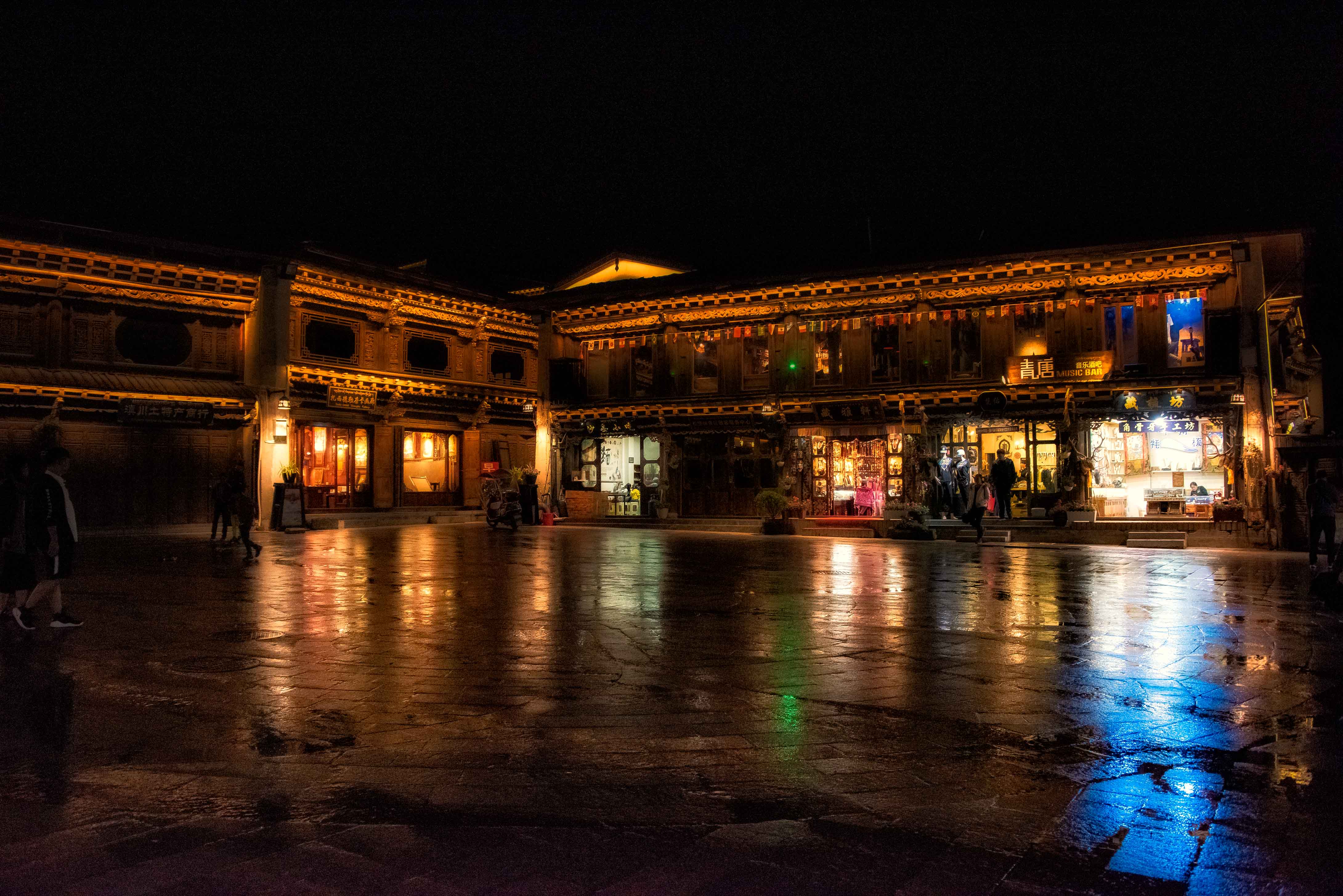
In daylight, many famous towns show you their surfaces.
At night, Shangri-La shows you its temperament.
The square widens. The wood turns dark gold. Prayer flags and carved facades lose their touristic explanation and become part of a colder, quieter highland stage. The wet stone after rain or washing carries light unevenly. Shops close. A few remain bright. People move more slowly, not because the town is performing slowness, but because the altitude, temperature, and darkness have already edited their speed.
Dukezong is often at its best in these hours. The fantasy name “Shangri-La” becomes less embarrassing then. The place feels less like a brand and more like a settlement holding its own warmth against the night.
Songzanlin changes the scale of the route
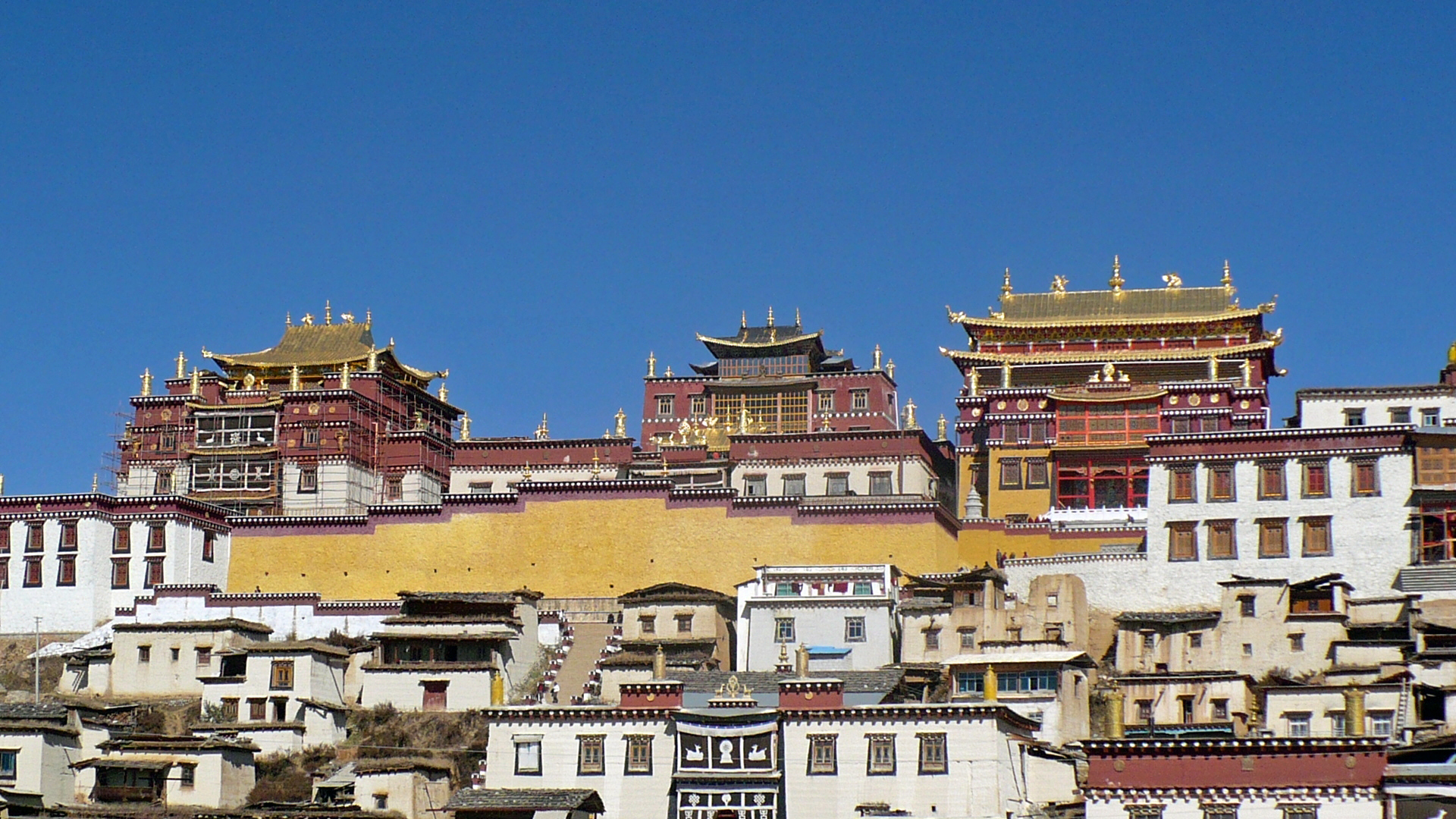
If Dukezong offers texture, Songzanlin Monastery offers authority.
This is where many travelers understand what Shangri-La is doing inside a Yunnan route. The monastery does not simply add one more sight. It changes the proportion of everything around it. Walls broaden, color deepens, ornament becomes doctrine rather than decoration, and the route that had felt like tourism begins to carry the quiet pressure of religious architecture and plateau history.
That does not mean every visitor has a mystical experience there. It means the town suddenly stops being small.
Where Lijiang charms, Shangri-La clarifies
This is not a contest between the two.
Lijiang is one of China’s great welcoming cities. It knows how to flatter the traveler’s senses. Shangri-La knows how to strip some of that ease away. It exchanges hospitality of surface for hospitality of distance. It asks you to earn the mood a little.
That is why the two cities belong together so often. One opens the imagination. The other cools it down and gives it height.
The name is a fantasy. The place is not.
Few Chinese destinations carry a title so overburdened by foreign desire. “Shangri-La” arrives pre-scented with utopia.
The real place is much less obliging.
It is a town where the first afternoon may need rest, where the sky can feel too large, where dryness enters the lips and skin, where monastery space outlasts the camera, and where the traveler is reminded that transcendence, if it appears at all, usually comes through patience rather than through branding.
And yet that is precisely why the name survives. The actual town is firmer, colder, and more credible than the fantasy attached to it.
Why Shangri-La is usually the right finish
Most Yunnan branches that include Shangri-La work best because the town lands at the end.
It is not simply higher in altitude. It is higher in emotional cost and reward. The route feels quieter here, less interested in pleasing, more interested in settling into its own cadence. If you end in Shangri-La, the trip keeps rising after the scenery has already begun.
That is difficult to manufacture elsewhere.
A better shape for this version of Shangri-La
If you want the place to feel memorable rather than merely dutiful, a stronger shape usually looks like this.
Day 1: arrive defensively, not heroically
Use the first day to do less:
- check in
- walk a little
- watch what the body says
- let evening come early if it wants to
This is not wasted time. It is the town’s admission ritual.
Day 2: choose one serious layer
Make one thing the center:
- Dukezong and the town’s own rhythm
- Songzanlin and the monastery scale
- or one wider plateau-facing branch if the route is built that way
The town nearly always gets thinner if it has to prove itself through too many symbolic stops in one breathless day.
Day 3: leave only after the place has actually touched you
If Shangri-La is worth coming to, it is worth leaving properly.
Do not make the stay so defensive that you only survive it. The point of the higher finish is not endurance. It is a different kind of stillness.
Practical details that actually improve Shangri-La
This kind of feature should still help people travel better.
The first afternoon is part of the attraction
Travelers often think the first half-day is dead time. In Shangri-La, it is often the most honest part of the stay. It tells you immediately whether your route has left enough room for altitude and weather to be real.
The town rewards edited ambition
Two or three days is often enough. More time only helps if you want the plateau mood itself, not just more named sites.
Shangri-La is usually worse when you arrive to conquer it
This is the classic mistake. The town is not a summit to be checked off. It is a slower register of travel that only becomes available when the route stops trying so hard.
The deeper reason to come
People say they go to Shangri-La for Tibetanness, for monasteries, for mountain air, for some last dramatic note in Yunnan.
Often they are really going because the trip needs silence.
Not silence in the literal sense, though that helps, but silence as a design principle: fewer distractions, wider intervals, colder light, a thinner atmosphere between self and sky. Shangri-La is where Yunnan stops entertaining and begins to resonate.
That is why the town can feel severe at first and necessary later.
FAQ
Is Shangri-La worth visiting if I am not a serious hiker?
Yes. Hiking helps some routes, but Shangri-La can still be deeply worth visiting for travelers who want highland atmosphere, monastery scale, Tibetan cultural texture, and a route finish that feels quieter and farther from ordinary urban tempo.
Why does Shangri-La feel so different from Lijiang?
Shangri-La is higher, thinner, drier, and less eager to charm. Where Lijiang often receives the traveler through beauty, Shangri-La works through stillness, altitude, and a stronger sense of distance from the lowlands.
What kind of traveler tends to love this deeper version of Shangri-La?
It works especially well for travelers who like fewer distractions, colder light, monastery towns, big sky, and destinations that ask for patience before they reveal their emotional center.