Key Takeaways
- The strongest deeper Harbin trip usually balances one signature winter night, one central-city walking day, and one slower food-or-river layer instead of treating the city as a single festival errand.
- Harbin feels distinctive because Russian and northeastern Chinese traces still live inside the same streets, tables, and winter habits rather than surviving only as decoration.
- The city's real charm is not only visual. It comes from how people organize warmth, meals, movement, and sociability against serious cold.
- Foreign visitors usually enjoy Harbin more when they stop asking whether it is 'worth the cold' in the abstract and start reading the cold itself as the city's main cultural force.
Many cities use weather as backdrop.
Harbin lets weather run the government.
That is the first thing worth understanding.
The cold here is not an inconvenience attached to sightseeing. It is the central fact from which the city learned its manners, appetite, architecture, and pace. People walk differently. They eat differently. They measure distance differently. They value interiors differently. Evening means something different when the air outside can bite any exposed skin in seconds.
This is why Harbin cannot be read correctly as a novelty winter stop alone.
Yes, there are ice palaces, floodlit sculptures, giant slides, and the strange civic confidence required to build fantasy out of frozen river water. But the city becomes more moving once you notice the smaller northern intelligence beneath the spectacle: the way warmth is hoarded and shared, the way meals stretch, the way facades carry another historical climate inside them, the way a street can look hard and still feel hospitable.
If you want the rest of our Harbin coverage in one place, start with the Harbin destination hub.
Who this is for
This guide is for readers who want a better answer to questions like these:
- what actually makes Harbin memorable beyond the ice festival headlines?
- why does the city feel so different from the rest of an ordinary first China route?
- how do architecture, food, river life, and winter habit fit together?
- what kind of traveler connects with Harbin as a city rather than only as an event?
If your question is narrower, these pages may be the better tool:
In practice
The strongest deeper Harbin trip usually balances three versions of the city:
- the frost line of river wind, hard light, steam, and the practical discipline of deep winter
- the facade city of Central Street, Saint Sophia, older shopfronts, and a northern urban memory that still feels oddly continental
- the warm table of bread, sausage, dumplings, stews, beer, and the social seriousness of getting out of the cold properly
If you only do the famous winter venue, Harbin can feel visually impressive but culturally thin.
If you only walk the central streets and skip the city’s winter scale, you miss the force that made Harbin famous in the first place.
The richer version lets Harbin feel theatrical without becoming artificial, and severe without becoming unfriendly.
The city at the frost line
One reason Harbin stays in the memory is that it forces the traveler to take climate seriously again.
Cold here is not style. It is structure.
Many winter destinations sell snow as charm.
Harbin goes further. It presents winter as a complete operating system.
The body becomes part of route planning. A straight walk on a map may no longer be a trivial walk. A warm cafe becomes an urban tool, not a lifestyle accessory. A hotel lobby, a bowl of soup, a bakery, a shopping arcade, a subway entrance, all gain strategic importance.
This changes the emotional texture of the trip. Harbin is not only seen; it is managed. That management is part of the city’s character. The people who live here have spent generations turning exposure into habit, habit into efficiency, and efficiency into something close to elegance.
Severe weather sharpens the city instead of blurring it
There is a paradox here.
The colder Harbin gets, the more clearly itself it seems to become.
Facades look cleaner. Smoke, light, and breath become visible. Night arrives with intent. Sound travels differently across snow. Small comforts become larger in meaning. The city stops competing with milder Chinese urban pleasures and starts offering its own vocabulary altogether.
That is why Harbin often feels weaker in abstract discussion than in direct experience. You do not merely visit it. You submit, a little, to its terms.
The facades remember another map
Harbin is one of the Chinese cities where architecture still changes the mood before it changes the itinerary.
Central Street works because it is more than decoration
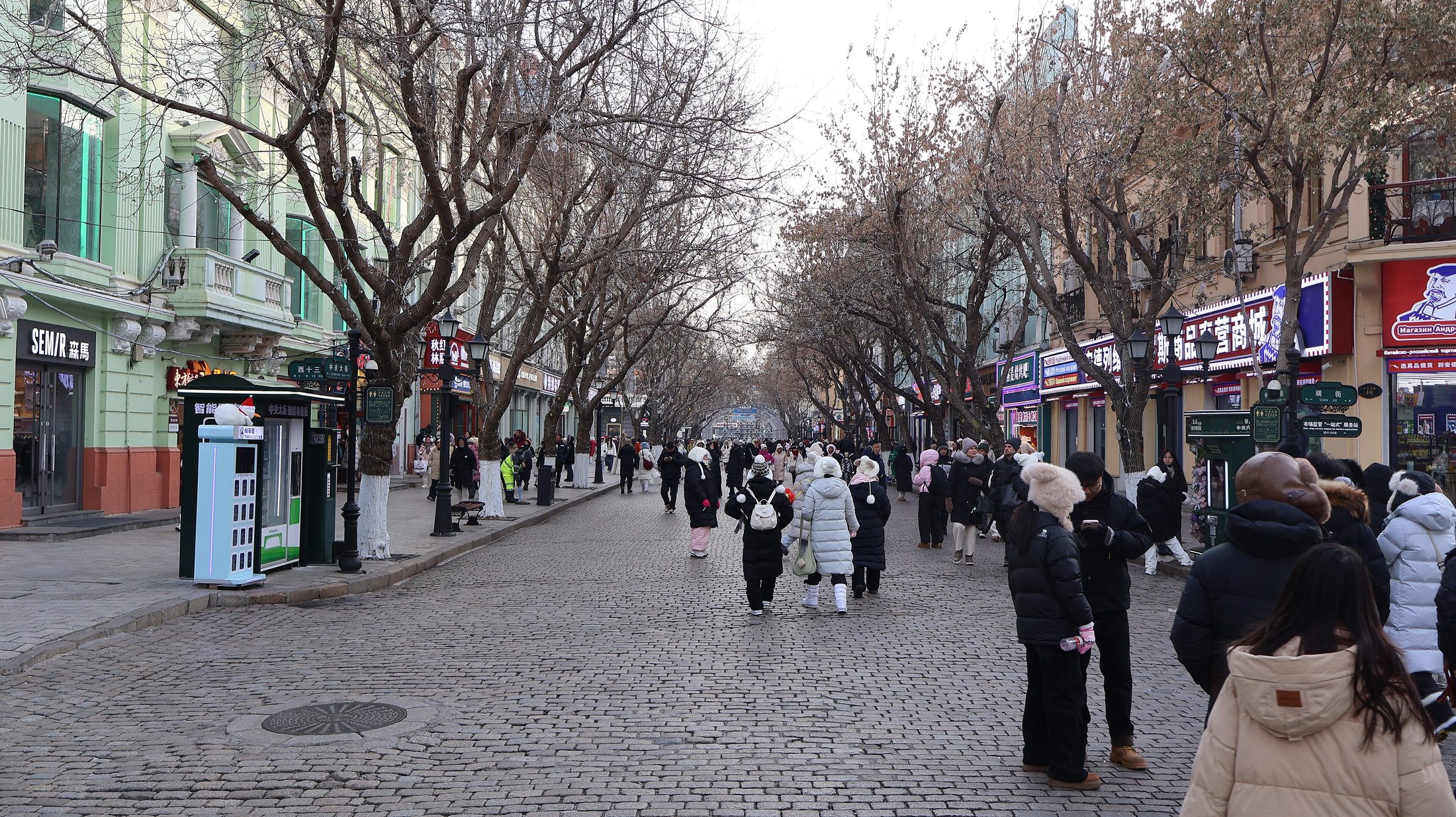
Zhongyang Street is often described too lazily as European style.
That phrase is not wrong, but it is shallow.
What matters is not only that the street carries Russian and Central European traces. It is that those traces survived long enough to become part of Harbin’s ordinary self-image. They are no longer stage props for a foreign fantasy. They belong to the city’s winter logic now: broad facades, solid walls, bakery culture, a slightly continental street rhythm, and a public realm that still feels designed for looking, strolling, and returning indoors.
Harbin’s older built environment does something unusual in China. It makes the city feel open to the north, open to another historical weather system, open to a borderland imagination in which China never looked only inward.
Saint Sophia is strongest as mood, not as monument
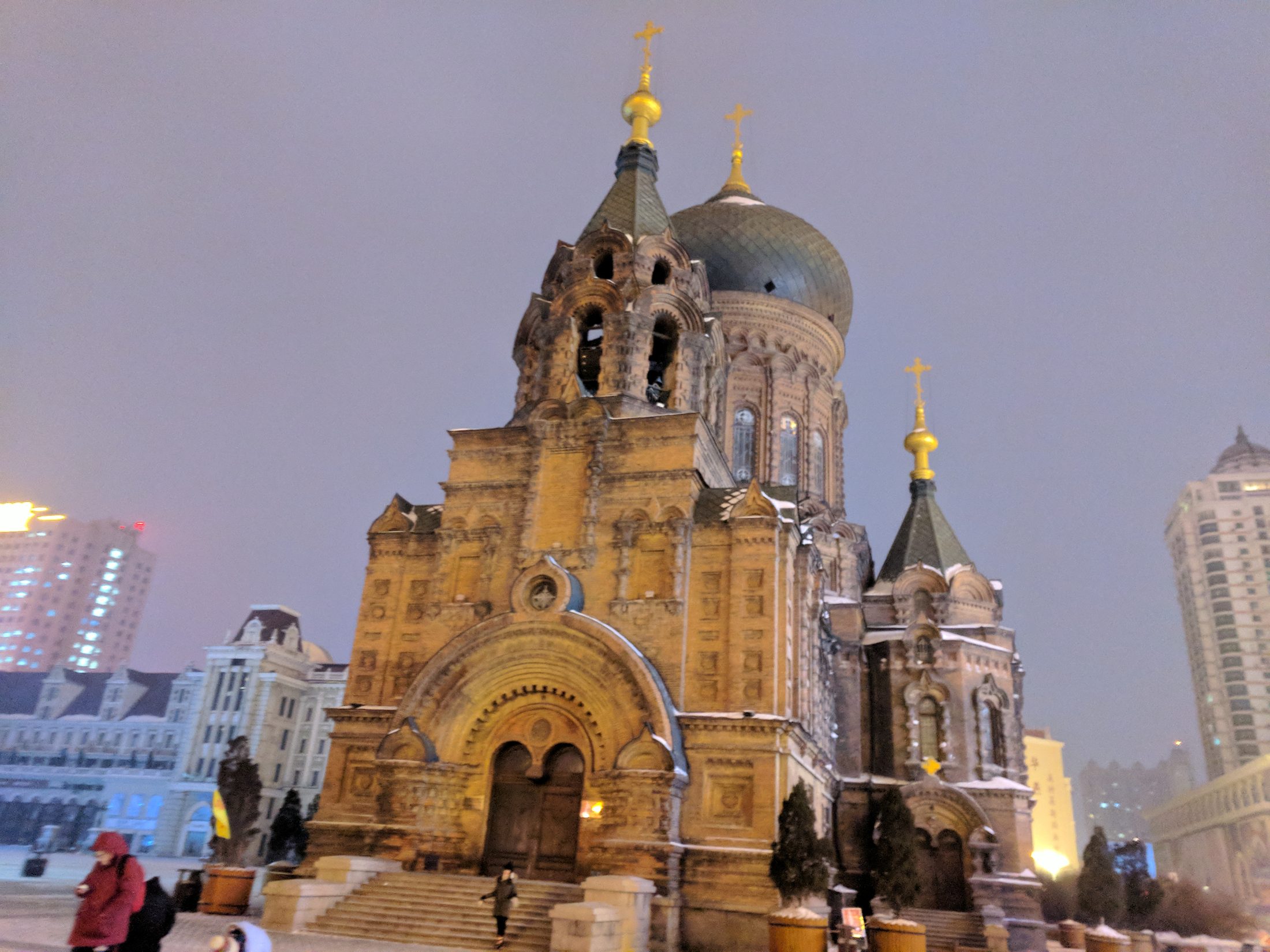
Saint Sophia Cathedral matters less as an isolated attraction than as a clue.
Its onion dome in the cold, its brick, its silhouette against snow or hard winter light, all tell you that Harbin once occupied a very particular threshold between empires, routes, and languages. The cathedral becomes more meaningful when folded into a wider city walk rather than treated as a stand-alone box to tick.
This is true of Harbin generally. Its identity gathers force in sequence: one street into one square, one warming stop into one church view, one facade into one meal. The city likes accumulation more than climax.
If this branch is already pulling at you, Zhongyang Street in Winter: Where to Walk, What to Eat, and How to Stay Warm is the strongest practical next read.
Warmth here is a public value
To understand Harbin, it helps to stop romanticizing endurance and start observing comfort.
A northern city is judged by how it gets you back inside
One of Harbin’s quiet civilizational achievements is that it knows how to rescue people from the outdoors.
Bread, soup, dumplings, roast meat, sausage, hot drinks, shopping passages, heavy doors, thick curtains, better-heated interiors than many first-time visitors expect: these are not side notes. They are how the city keeps winter from turning into punishment.
This is why Harbin food often feels so emotionally correct. It is not merely regional cuisine to sample. It is part of a larger civic answer to the climate.
Russian traces survive best at the table
Travelers often look for Harbin’s Russian inheritance in domes and facades first.
In fact, some of it survives more intimately through bread, cured meat, dairy habits, soup, and bakery culture. The city still carries a taste memory that separates it from most first-route Chinese destinations. Even when dishes are thoroughly local in daily life, the wider table still hints at a colder, northern, more Eurasian story.
That is why Harbin meals can feel so anchoring. They are not flashy. They are heavy in the right places, practical without being crude, and built around the assumption that eating should restore the body, not simply entertain it.
If food is your route into the city, keep Harbin for First-Time Visitors: When the Winter Spectacle Is Worth Building a Trip Around and What to Do in Harbin at Night for First-Time Visitors nearby.
The long northern night
Many cities try to extend the evening.
Harbin begins there.
Darkness is part of the experience, not a leftover after the daytime plan
The city is one of China’s clearest examples of a destination whose strongest hours often arrive after sunset in winter.
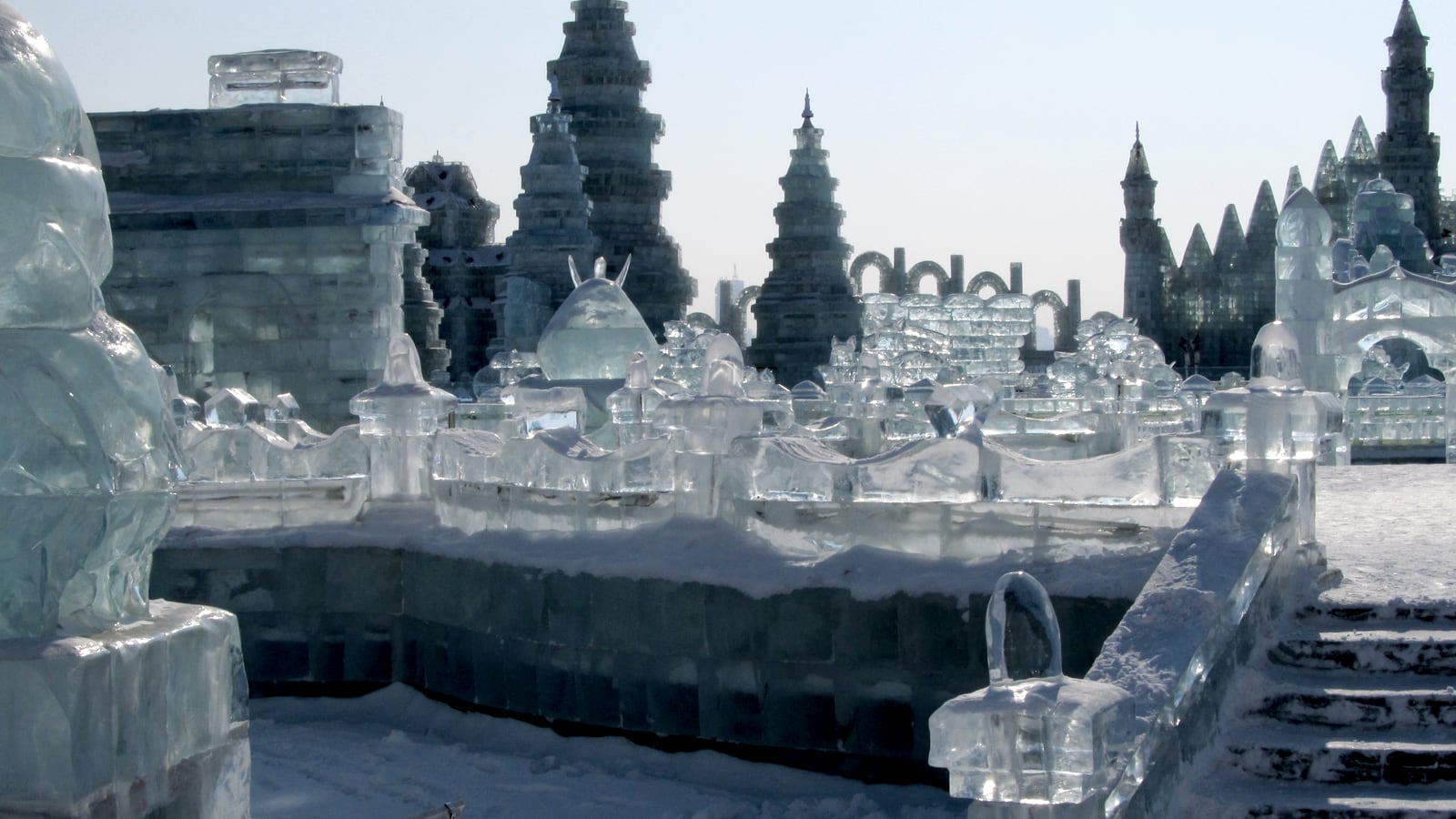
This is partly visual. Ice and snow receive light in an almost theatrical way. Steam, shadow, blue hour, and floodlit sculpture make the city look staged by climate itself. But it is also social. Harbin’s evening has purpose. People do not simply wander because there is nightlife to consume. They move because the night, in winter, becomes the main dramatic surface of the city.
Harbin Ice and Snow World is the obvious expression of that truth, but not the only one. Even a smaller evening of lit streets, shop windows, a proper meal, and the walk back through snow can explain Harbin better than an overbuilt daytime checklist.
The winter spectacle is real, but it should not be asked to do all the work
This is where first-time visitors sometimes flatten the city.
They assume the entire value of Harbin rests inside one fenced venue. The venue matters enormously. But Harbin becomes a better trip when the spectacle is allowed to sit inside a fuller city chapter: one central day, one proper meal logic, one hotel base that understands cold, one protected evening rhythm.
Without that, the famous images can start to feel curiously detached from the city that produced them.
Harbin’s temperament is plainer than its visuals
This is one reason the city remains likable.
The iconography is extravagant. The local temperament is not.
Harbin often feels blunt, straightforward, unembroidered. It belongs to the northeastern Chinese tradition sometimes described as more direct, less fussy, quicker to warmth once formal distance is gone. That social texture matters. It prevents the city from becoming too ornamental in the mind.
Under the snow sculpture and imported architectural shadow, Harbin remains a practical place.
That practicality is not a disappointment.
It is what gives the city weight.
A better shape for this version of Harbin
If you want Harbin to feel like a city rather than an event, a stronger shape usually looks like this.
Day 1: arrive, get warm, claim the center
Use the first half of the stay to understand the city’s basic emotional grammar:
- one real central walk
- one shorter architectural or church-side layer
- one meal that allows Harbin to start feeling inhabited
This is the day when the facades should begin to mean something.
Night 1: protect the winter climax
This is the evening to decide whether the city earns its cold.
Protect one serious winter night, whether that means the flagship venue or a smaller but still deliberate dark-hours branch. Harbin needs one evening that belongs to it fully.
Day 2: give the city back some ordinary life
The second day is often when Harbin becomes real.
Not because it stops being beautiful, but because the visitor starts reading how beauty and routine coexist here: bakery windows, bundled commuters, river wind, warm interiors, one more meal, one more stretch of central city. Harbin improves when one block of life is allowed to remain ordinary.
Practical details that actually improve Harbin
This kind of feature should still help people travel better.
Harbin usually weakens when overscheduled
The cold amplifies every planning mistake.
Too many disconnected outdoor errands can make the city feel like a punishment disguised as an itinerary. Harbin nearly always improves when the route stays selective and lets one strong night and one strong central day do most of the work.
Your hotel matters more than in milder cities
In Harbin, a mediocre location is not merely inconvenient. It can become exhausting.
The right base protects returns, warming breaks, and evening pacing. The wrong base can make the whole stay feel longer and colder than it is. If this decision still is open, Where to Stay in Harbin on a First Trip: Central Street Convenience or a More Practical Winter Base? is one of the highest-value pages in the cluster.
Harbin should usually be treated as a focused chapter
For most first-time visitors, two or three days is enough.
It keeps the city concentrated. Harbin is at its best when it enters the route like a strong winter sentence, not a paragraph that keeps trying to become something broader and less precise than it really is.
The real attraction
The real attraction in Harbin is not ice alone.
It is the civilization built around ice.
The facades imported and weathered by another history. The foods that understand cold as a daily condition rather than a seasonal inconvenience. The long night that gives the city its drama. The plainness of local manner beneath the ornamental winter shell. The deep northern competence of staying warm without making a fuss about it.
That is why Harbin lingers.
Not because it is exotic.
But because it is one of the few major destinations left that still allows climate to shape character in full public view.
FAQ
Is Harbin only worth visiting during the ice festival season?
Harbin is strongest in winter, and the ice-festival season is the clearest reason many travelers go, but the city's appeal is broader than one venue. It also lies in the architecture, food, riverfront mood, and the daily social choreography of living well in severe cold.
Why does Harbin feel different from other major Chinese cities?
Harbin combines northeastern bluntness, Russian and Central European architectural traces, long winter nights, and a social life built around heat, food, and resilience. The city feels physically and emotionally different from China's more temperate urban centers.
What kind of traveler tends to love this deeper version of Harbin?
It works especially well for travelers who like winter cities, strong atmosphere, architecture, hearty food, and destinations where climate still determines how people move, gather, and spend their evenings.